
POS Features That Matter: The 7 Best Ones, and 6 to Ignore
Comparison tables reward length, so POS features multiply. A shop uses perhaps ten of them. The useful question is not how many a product has, but whether each one removes a job somebody is doing by hand today. Our feature documentation is written against that test.
What follows is the seven POS features that genuinely change how a counter runs, six that rarely earn their place, and how to tell them apart on a demo.
On this page

The test for any feature
Ask one question of every item on the list. What job does this remove, and who is doing that job now?
If the answer is specific, the feature is real. If it is a benefit rather than a job, it is usually decoration.
Stock that moves on every sale removes the job of counting shelves. A dashboard with eight charts removes nothing; somebody still has to decide what to do.
The POS features that actually matter
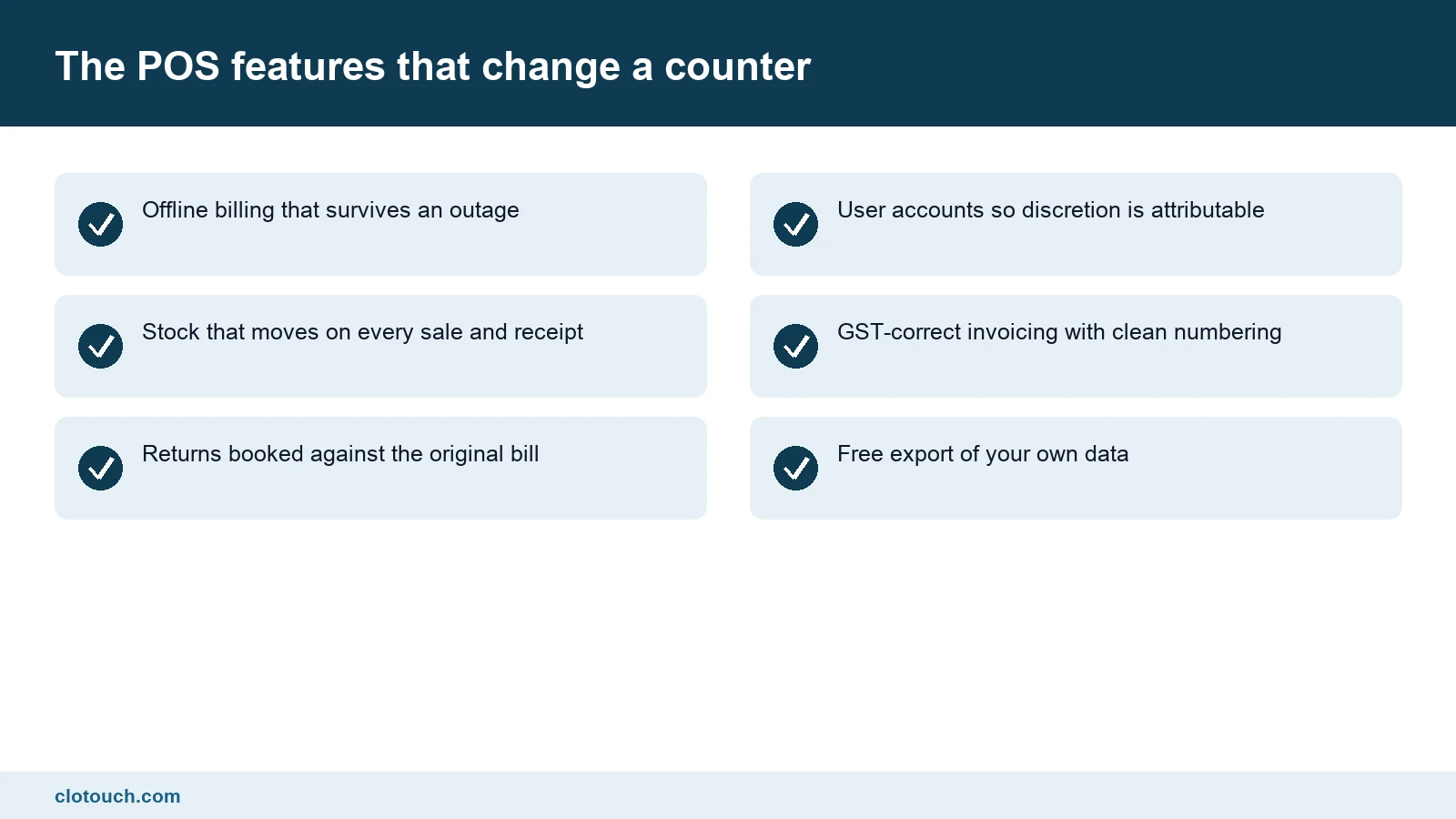
Offline billing. A counter that stops during an outage stops trading. This is the only feature whose absence can close a shop for an afternoon.
Stock that moves on sale and on receipt. Both sides. A system that decrements on sale but relies on manual receipts produces a figure that drifts within weeks.
Returns against the original bill. Without the link, a return is an untracked refund and an untracked stock movement.
User accounts with roles. This converts a discount or a void from an argument into a record with a name on it.
GST-correct invoicing. Per-line rates, HSN codes where applicable, and an unbroken number series across counters. This is a floor, not a differentiator.
Free data export. Not a feature anyone demos, and the one that decides whether you can ever change vendor.
A search that works. Fast partial-name lookup matters enormously in Indian retail, where plenty of stock has no barcode at all.
The POS features that rarely earn their place

None of these are useless. They need an owner, and in a small business there usually is not one.
Loyalty is the clearest example. A points scheme without somebody watching redemption becomes a standing discount to customers who were already coming. The same applies to promotions nobody reviews.
Forecasting deserves a particular caution. A model built on stock figures you do not yet trust produces confident numbers from bad data, which is worse than no number.
Features that matter only for certain trades
A long list of general POS features hides the one capability that decides suitability for your trade.
| Trade | The feature that outranks everything | Why |
|---|---|---|
| Grocery and kirana | Scale integration and khata credit | Half the basket is loose and half the customers run tabs |
| Supermarket | Sustained scan rate | The queue is the product |
| Restaurant | Kitchen tickets routed by section | Cooking must start before pricing |
| Cafe | Priced modifiers | Nearly every item is customised |
| Pharmacy | Batch and expiry capture | Law requires the record, not the convenience |
| Electronics and mobile | Serial and IMEI tracking | A warranty claim is a search |
| Apparel | Size and colour variants | One style is many stock items |
If a product cannot do the row that matches your trade, the rest of its feature list does not compensate. The full ordering is in our choose by business type guide.
Hardware support is a feature nobody lists
Feature lists describe software. The thing that most often stops a deployment is a peripheral that will not talk to it.
Scanners are usually fine because they behave as keyboards. Printers are usually fine. Weighing scales are where setups fail, because reading a scale needs explicit support rather than a generic driver.
If you sell loose goods, make a live test with your own scale a condition of purchase. It belongs in the stock conversation as much as in the hardware one.
The feature that only matters at the second outlet
Central item masters look like an enterprise concern and become urgent the day a second shop opens.
Two outlets maintaining their own product lists diverge within weeks. Every group report built on top of them is then unreliable, and nobody can say which shop’s number is right.
If a second outlet is plausible within a year, treat central masters as essential rather than optional, which is what a multi-store setup provides.
Training is the hidden feature
A capability nobody can use is not a feature. In Indian retail, counter staff turn over, so the real measure is how long it takes a new person to become useful.
The practical test is whether somebody who has never seen the system can complete a mixed basket after five minutes of explanation.
Put the person who will actually bill in front of the demo and watch where they hesitate. That tells you more about the POS features you are buying than the list does.
Reports are a feature too, and most are not used
Reporting is where POS features are sold hardest and used least.
Four reports earn their place in most shops. Sales by hour, for staffing. Margin by category, for what you actually earn on. Stock ageing, for what is about to be written off. And the override log, for discretion at the counter.
Ask to see those four on real data during a demo, not on the vendor’s sample database. A report that takes four clicks to find will not be opened in a real week.
Integrations count as features, with a catch
A long integration list is impressive and frequently inert.
What matters is what happens when a sync fails, and where that failure appears. If the answer is a log file, the practical answer is that nobody will see it.
Connect what removes a job you are doing today and leave the rest. Each connected system is another surface somebody has to watch.
How to read a feature list honestly
- Cross out anything that does not name a job it removes.
- Circle the one capability your trade cannot do without.
- Ask for a live demonstration of offline billing, not a description.
- Print a real GST invoice and check it line by line.
- Ask what the last three software updates contained and when.
- Ask whether exporting your own data costs anything.
- Ignore the remaining count entirely.
Step five is the cheapest way to tell a maintained product from an abandoned one. Tax rules change, and a product that shipped nothing for the September 2025 rate restructure is a product nobody is looking after.
Step six is the one buyers regret skipping, because it is the difference between choosing a system and being held by one.
One closing note on POS features. The product that wins a comparison sheet and the product still working well in two years are rarely the same one. Buy for the seven that remove a job, and treat the rest as packaging.
Frequently asked questions
Which POS features actually matter?
Offline billing, stock that moves on both sale and receipt, returns booked against the original bill, user accounts with roles, GST-correct invoicing, free data export, and a fast partial-name search.
How do I judge a feature on a demo?
Ask what job it removes and who is doing that job now. If the answer is specific, the feature is real. If it is a benefit rather than a job, it is usually decoration.
Is loyalty worth having in a POS?
Only if somebody will own it. A points scheme with nobody watching redemption becomes a standing discount to customers who were already coming. The same is true of promotions nobody reviews.
Are AI forecasting features useful?
Not until your stock data is trustworthy. A model built on figures that drift produces confident numbers from bad data, which is more dangerous than having no number at all.
Which feature matters most for my trade?
It differs. Scale integration for grocery, scan rate for supermarkets, kitchen tickets for restaurants, priced modifiers for cafes, batch and expiry for pharmacy, serial tracking for electronics, and size-colour variants for apparel.
Sources, method and author
Method. The division between features that change a counter and features that rarely get used reflects POS deployments Clonet Technologies runs across Indian retail, food and pharmacy. GST invoicing points were checked against the GST portal in September 2026. No usage percentages are quoted, because we have not surveyed the market and will not imply that we have.
- Goods and Services Tax portal — invoice content and numbering requirements
- NIC e-Invoice portal — IRN registration above the turnover threshold
- Legal Metrology — weighing and packaged commodity requirements
- GS1 India — barcode standards, and why some stock has none
Disclosure. Clonet Technologies Pvt Ltd builds and sells Clotouch POS and therefore publishes a feature list of its own. This article argues against judging any product, including ours, by the length of that list.
Author. Aman Raj. Rewritten 24 September 2026 for Clonet Technologies Pvt Ltd, Bengaluru.


